Log management Service
-
Design a service that collects Logs from network devices(firewalls,
routers, switches) and supports full text search over ingested log
corpus.
Requirements
Functional
-
1. Inject (POST): Accep a batch of log events(JSON) from devices, return
an injestion acknowledgment.
2. Search: Accept time range, filter parameters and full text query, return matching log entries with parameters
3. Alerts (Management): Register or update an alert rule(eg: regex match or threshold over time window); return alert
4. GET alerts/[alert id]/status: Return current status of the alert(active/inactive), recent firing timestamp
Non Functional
-
High Throughput: System should injest logs from tens of thousands
of devices, sending millions of events per second
HLD
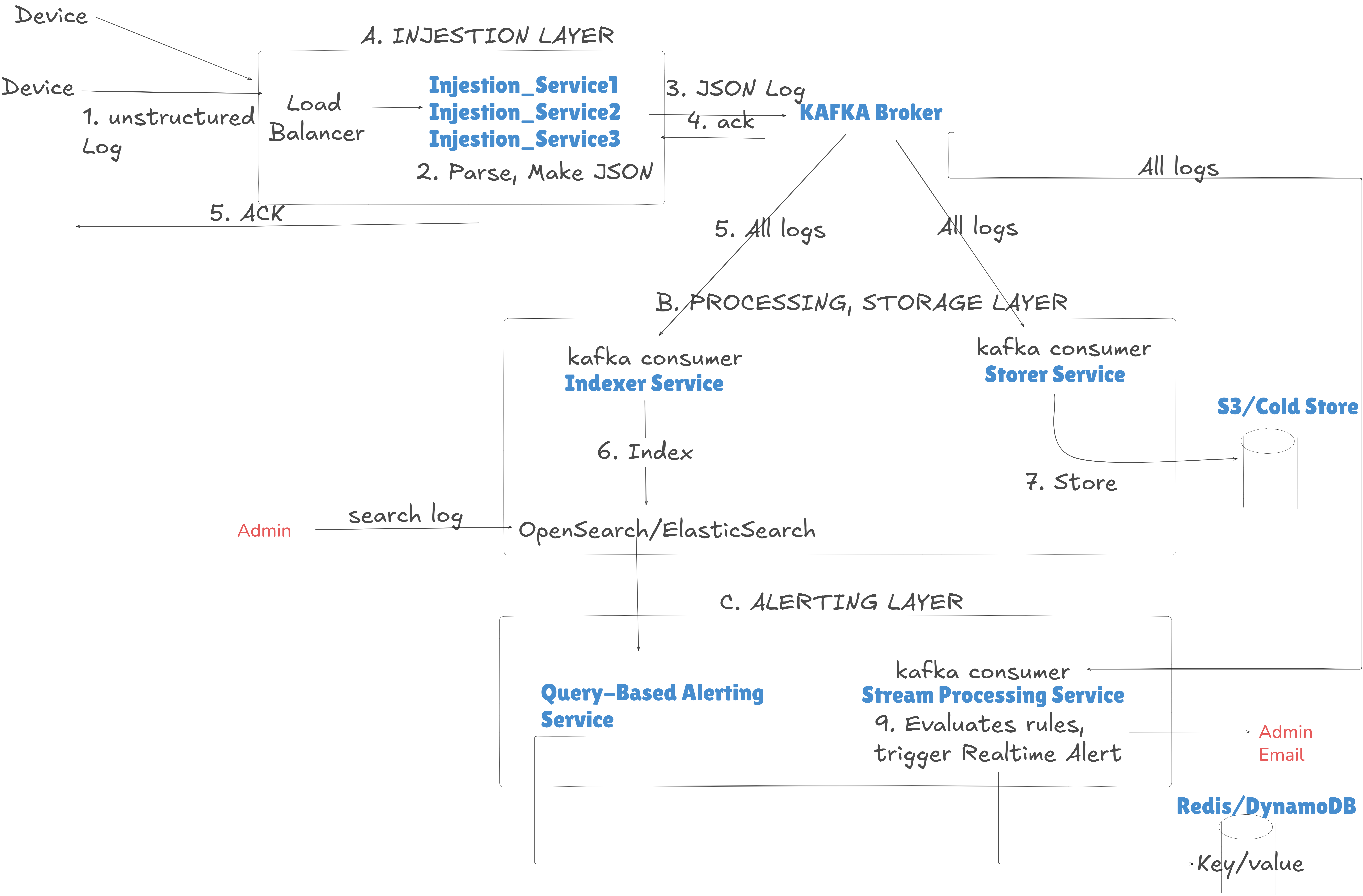
A. Injestion Layer
A1. Ingestion Service (The "Validator & Router")
-
Receive a raw string, turn it into a structured object(JSON)+add meta
data unique uuid
Ingestion Service writes to Kafka(not the database) This is because no database can handle the raw, unbuffered "firehose" of a million writes per second without a queue in front of it.
Functions of Injestion Service:
1. Parse: It breaks the string into a JSON object
2. Enrich: It adds metadata (like the IP address of the device or a unique log_id)
3. Route: It pushes the log to a Kafka topic.
Input= "tenant-A 1707312000 ERROR auth-mod Login failed for user 123"
Output:
{
  "tenant": "tenant-A",
  "timestamp": "2026-02-07T12:00:00Z",
  "level": "ERROR",
  "module": "auth-mod",
  "message": "Login failed for user 123",
  "ingest_id": "uuid-987"
}
B. Processing & Storage Layer
B1. Indexer Service (The "Search Engine Writer")
-
It consumes from Kafka topic and prepares data for
OpenSearch(SSD-based).
- Since SSD is expension, Index all logs for the last 7 days.
- OR, index only Critical/Error/Warn for 30 days and ignore "Debug" entirely.
B2. Storer Service (The "Archivist")
-
Stores everything. It writes the raw JSON to S3 (Cold Store) in
compressed formats like Parquet.
Why store in cold Store/S3? If OpenSearch crashes or you need to perform a "Forensic Audit" from a year ago, you go to S3. It is 1/10th the cost of OpenSearch.
It waits until it has a large chunk of data (e.g., 100MB or 5 minutes of logs) and uploads a single file to: s3://logs/tenant-A/2026/02/07/logs_1200.parquet.
C. Alerting Layer
-
Alerting usually happens in one of two ways: Real-time or Scheduled.
C1. Stream Processing Service(Flink/Spark Streaming)
-
For "Real-time" alerts (e.g., a regex match), a service consumes
directly from Kafka, evaluates the rule, and triggers an alert
immediately.
C2. Query-Based Alerting Service
-
For "Threshold" alerts (e.g., "more than 500 errors in 5 minutes"), a
service periodically runs a count query against the Search Engine.
C3. Alert State Store
-
A fast Key-Value store (like Redis or DynamoDB) to track the
[alert_id]/status (active/inactive) and firing timestamps.