What is Mobile Billing System
-
In telecom platforms, large subscription businesses (like Rakuten),
systems are usually split into:
1. OSS (Operational Support Systems) → network operations, provisioning, monitoring
2. Mobile Billing System/BSS (Business Support Systems) → customers, products, billing, payments, revenue.
Requirements
Functional
-
1. Monthly data pack subscriptions: Support states(Active,
Expired, Suspended, Cancelled)
2. Pack Expiry Handling: When a pack reaches its expiry: Service usage must be blocked, Customer is notified (SMS / Email / App), Account state updated.
Billing system does NOT directly stop network service → It notifies OSS / Network Control
3. Accept Payments & Renew: System shall accept customer payments & renew
4. Failed Payments: Do not renew pack, Retry payment based on policy, Notify customer
5. Refund & Adjustment: Full, Partial, Manual(policy based)
6. Overlimit Usage: Prevent usage beyond allowed quota. Soft limit (throttle), Hard limit (block)
7. Billing history: Store to show to customer
Non Functional Requirements
-
1. Scalable: if new customer come in, system should scale
2. High Availability: 99.9%+ availability. Multi AZ deployment
3. Consistency: No duplicate billing
4. Reliable: if billed once, it should not tell not billed recharge
5. Latency: Low, pack activation instant
BOE
-
OSS(See HLD Diagram) will send CDR(Call Detial Records) in Batch to
BSS.
CDRs are send in BATCHES using Kafka from OSS to BSS
CDR ~= 300-500 bytes

| Field           | Reason              |
| --------------- | ------------------- |
| IMSI            | Subscriber identity |
| MSISDN          | Caller number       |
| Called number   | Receiver            |
| Call start time |                     |
| Call end time   |                     |
| Call duration   |                     |
| Cell ID         | Location            |
| MSC ID          | Network element     |
| Call type       | MO/MT               |
| Service type    | Voice/SMS/Data      |
| Cause code      | Call drop, reject   |
| Charging ID     | Correlation         |
| Roaming info    | Tariff impact       |
| Bearer type     | LTE/VoLTE           |
| Sequence number | Dedup               |
Storage estimates
-
Total users = 1M
Total calls/day/user = 30.
Outgoing calls = 15
1M users × 30 calls = 30M CDRs/day
30M x 300 = 9GB/day
9 GB × 365 ≈ 3.2 TB/year
3.2 x 5 ≈ 16 TB / 5 years
Traffic Estimates (Incoming bytes/sec)
-
5 calls/user/hour
1M × 5 / 3600 ≈ 1389 calls/sec
Incoming data = 1389 × 300 bytes ≈ 416,700 bytes/sec ≈ 407 KB/sec
Peak factor (3x or 5x)
- Telecom traffic is bursty
- Peak ≈ 407KB x 5 = 2 MB/sec
But we will design ingestion for ≥5 MB/sec to be safe.
Network Architecture
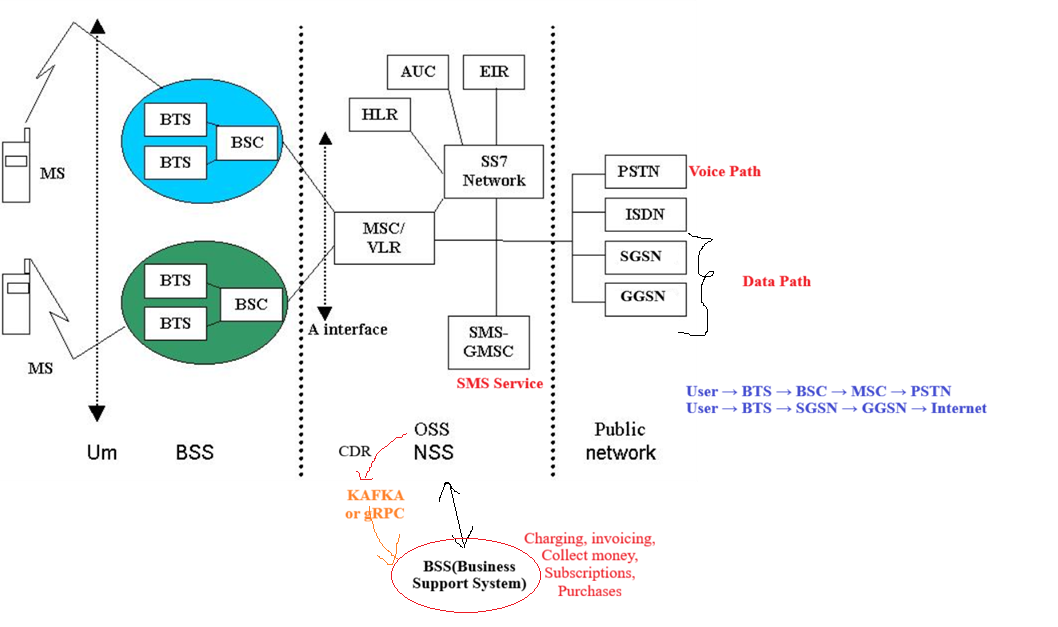
Database Schema/Tables
Subscriber table
|
Plans table: Rs 299, Rs 179, Rs 999
|
Products Table:
OTT(Netflix, Amazon, Zee) , data, voice, SMS
|
Plan_to_Product table
|
Subscription table
|
HLD
Flows
New Subscriber / Subscriber Purchases a SIM card
-
Person goes to shop and purchases SIM card, makes 1st recharge. This
message flows to BSS
OSS                        telcoBSS(Onboarding service)
  -- POST /v1/customers -->  REST_EndPoint
      json {                          --------INSERT INTO ------> Subscriber Table
        "imsi": "xxx",                     status=inactive     5 | ram | 25/2 | xxx | yy | inactive | 9jan |
        "msisdn": "yyy",
        "name": "ram",
        "dob": "1995-11-23",
        "kyc_status": "VERIFIED"
      }

    <------- Registered ---------------

  Connect Plan                  telcoBSS(Order Service)
  ---- POST /subscription/activate -->
      json {
        "imsi": "xxx",
        "plan_code": "279_PLAN",
        "payment_ref": "txn_123"
      }
                                      telcoBSS(Order Service)
                                      // Verify req is not duplicate? (idempotency key)

                                        -----------payment_ref: "txn_123" ---------> Payment_GW
                                        <------------Pending------------------------
                                        retry for 5 times
                                        <------------ success ----------------------

                                        BSS
                                        -- INSERT INTO ------> Subscription table
Verify Payment Status
-
Why Payment status need to be verified?
User → Payment Gateway / Wallet
            ↓
        Payment System
            ↓
          BSS
User will send money to payment gateway and this information will not come to OSS. When recharge is successful Payment Gateway will send this information to OSS asynchronously.
Update Plan from 299_PLAN to 999_PLAN
- Only subscription table need to be changed
OSS                      BSS
  -- update_plan --<  REST_EndPoint
                         ----- UPDATE ROW ------< Subscription table
Kafka Communication from OSS to BSS
Overall Flow
@startuml

actor "Customer Portal\nAdmin UI" as UI

box Microservices
participant "External\nAPIs" as API
participant "Onboarding\nservice(Go)" as ONB
participant "order\nservice(Go)" as ORD
participant "billing\nservice(Go)" as BILL
participant "Rating\nengine(C++)" as RATE
participant "Admin\nservice(Go)-Optional" as ADMIN
end box

queue "Kafka Topics" as KAFKA

box Databases
database "Couchbase" as CB
database "MySQL" as SQL
end box

box Observibility
participant "Prometheus" as PROM
participant "Grafana" as GF
participant "Kibana" as KB
end box

participant "Elasticsearch" as ELK

== Onboarding Flow ==

UI -> ONB : POST /v1/customers\n(subscriber data)
ONB -> CB : Store Subscriber (subscriber_id, name, dob, IMSI, MSISDN, status, etc.)
ONB -> KAFKA : Produce CustomerOnboarded (customer_events)
KAFKA -> BILL : Consume CustomerOnboarded
BILL -> SQL : Initialize Billing Account (Subscription table)

== Order Flow ==

UI -> ORD : POST /v1/orders (order data)
note over ORD
Mapping of
subscriber to
plan
end note

ORD -> SQL : Validate & Store Subscription(id, subscriber_id, plan_id, dates)
ORD -> CB : Store Order Details (orders collection)
ORD -> KAFKA : Produce OrderPlaced (order_events)
KAFKA -> RATE : Consume OrderPlaced
RATE -> RATE : Simulate Provisioning

== Admin Flow (Optional) ==

UI -> ADMIN : Manage Master Data\n(Plans, Products, Plan_to_Product)
ADMIN -> SQL : Fill Plans, Products,\nPlan_to_Product tables

== Data Usage Rating Flow ==

API -> KAFKA : Inject Usage Events\n(usage_events)
KAFKA -> RATE : Consume Usage Events
RATE -> RATE : Apply Rating Logic\n(bytes * rate)
RATE -> KAFKA : Produce Rated Events\n(rated_events)
KAFKA -> BILL : Consume Rated Events
BILL -> SQL : Create/Update Invoices\n(invoices, invoice_items)
BILL -> CB : Store Invoice Metadata\n(usage_records)
BILL -> KAFKA : Produce Billing Events\n(billing_events)

== Billing Query ==

UI -> BILL : GET /v1/invoices
BILL -> SQL : Fetch Invoice Data
BILL --> UI : Return Invoice

== Observability ==

ONB -> PROM : Send Metrics
ORD -> PROM : Send Metrics
BILL -> PROM : Send Metrics
RATE -> PROM : Send Metrics
PROM -> GF : Visualize Dashboards
ELK -> KB : Index Logs

@enduml
Terms
IMSI(International Mobile Subscriber Identity)
-
An IMSI number is a unique, 15-digit code that identifies a specific
mobile phone subscriber in a cellular network, stored on the SIM card
and used for network authentication, distinct from your public phone
number.
IMSI = {Mobile Country Code (MCC) + Mobile Network Code (MNC) + and Mobile Subscription Identification Number (MSIN)}